
Salesforce buying Fin (Intercom): what it means for your support bill
The deal is signed, not closed, and Fin's pricing hasn't moved. Here's Salesforce's dated post-acquisition track record — and what to check in your contract before renewal.
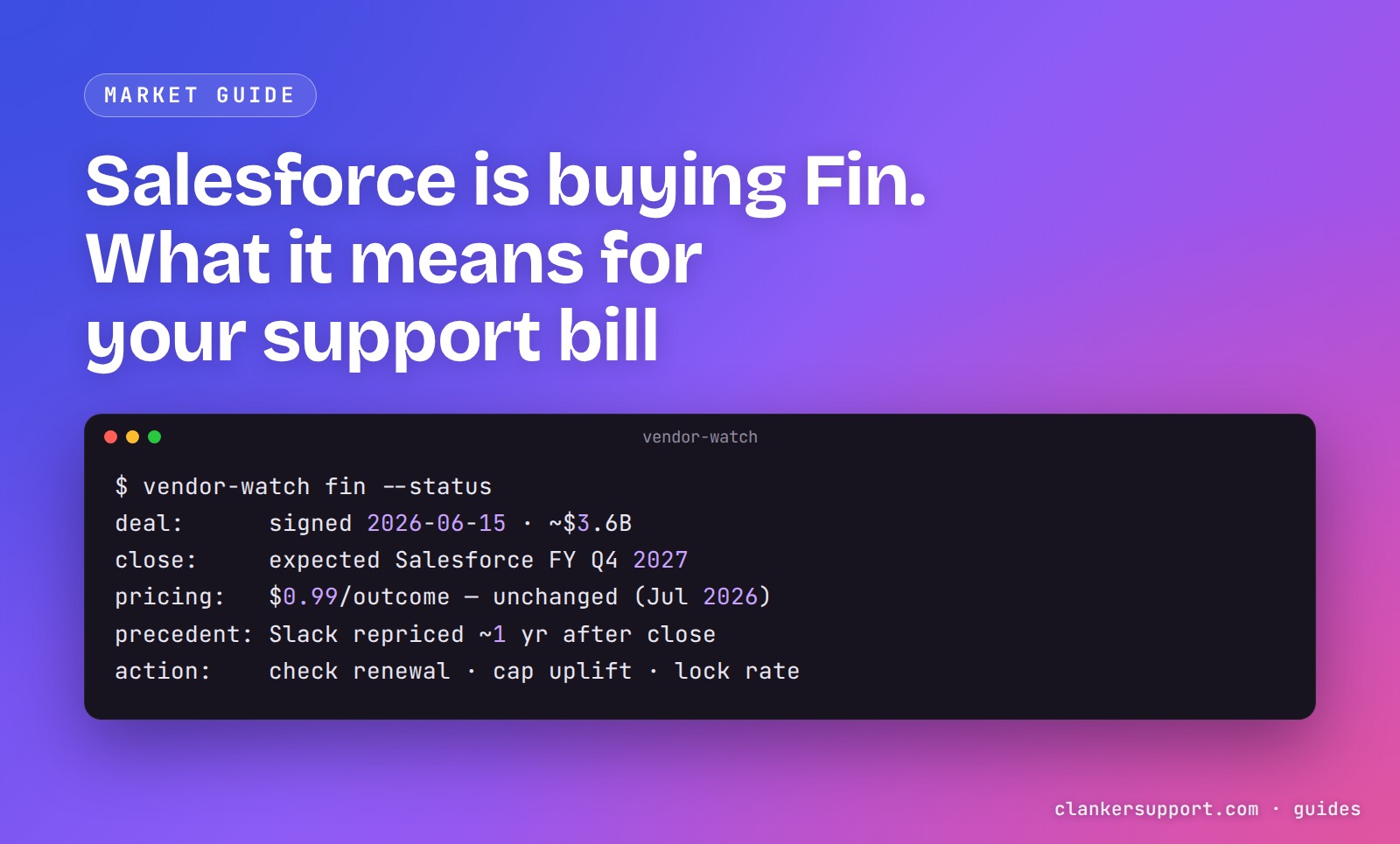
Salesforce signed a definitive agreement on June 15, 2026 to acquire Fin — the company formerly named Intercom — for approximately $3.6 billion. The deal has not closed, and Fin's published pricing is unchanged as of July 2026. Nothing changes on your bill today. But Salesforce's post-acquisition track record is public and dated, and it says your renewal terms deserve attention now, not after close.
We run Clanker Support, an open-source support agent, so we watch this market closely — and yes, we compete with Fin at the low end. Discount accordingly. Everything below is sourced and dated, and most of it is the kind of contract homework we'd recommend whether or not you ever look at an alternative.
What actually happened
The facts, as of July 11, 2026:
- May 12, 2026 — Intercom renamed the company Fin, after its AI agent. "Intercom" lives on as the platform name.
- June 15, 2026 — Salesforce announced a definitive agreement to acquire Fin for approximately $3.6 billion. Per CNBC's coverage and Salesforce's own materials, Fin brings 30,000+ customers, including names like Asana, Shutterstock, and Riot Games.
- Expected close — Intercom's announcement says "the fourth quarter of Salesforce's fiscal year 2027." That's roughly November 2026 through January 2027 — around the turn of the calendar year. The transaction is subject to regulatory clearances, which is standard deal boilerplate; no regulator has publicly announced a review as of this writing.
- The plan — Salesforce says Fin's team and technology will fold into Agentforce, its AI-agent platform.
Fin CEO Eoghan McCabe's framing, from the same announcement: "With the resources of Salesforce this will only accelerate. And yet little will practically change." He also said he'll remain CEO and co-founder Des Traynor will keep running R&D.
That quote is doing a lot of work, so it's worth saying what's verifiably true alongside it: as of mid-July 2026 the deal is signed but not closed, Fin's published pricing is unchanged, and there have been no announced packaging changes. If you want the full teardown of how Fin's $0.99-per-outcome model actually bills — assumed resolutions, the 50-outcome minimum, the add-on stack — we wrote that up separately in our Fin pricing teardown and won't repeat it here.
What happens between signing and close
Between a definitive agreement and closing, the acquired company legally operates as an independent business. In practice, for a SaaS vendor in this window, a few patterns are typical — none of which we can promise apply here, but all of which are worth knowing:
- Pricing usually holds still. Repricing mid-deal creates noise nobody wants. Fin's pricing has not moved since the announcement, and third-party pricing trackers (GetVoIP, for one) confirm the same as of July 2026.
- Contracts remain contracts. Your existing agreement binds the surviving entity after close. The terms you sign between now and close are the terms you'll live under during the integration — which is exactly why this window matters.
- Sales teams keep selling, and renewals keep renewing. If your renewal lands before the expected close (before roughly the turn of the year), you're negotiating with a company that has strong incentive to show clean retention numbers to its acquirer. That's leverage — the noun — for you.
- Roadmaps get cautious. Companies in this window tend to avoid big public commitments that could complicate integration planning. Again: pattern, not prophecy.
The one thing you should not do is assume the announcement itself changes anything. It doesn't. What changes things is the close, and everything Salesforce decides after it.
Salesforce's pricing track record, with dates
This is the part our earlier posts didn't cover, and it's the evidence that should anchor your planning. None of it proves anything about Fin specifically — these were separate decisions Salesforce attributed to product investment, not to acquisitions. But if you're trying to guess the pricing culture Fin is joining, this is the public record:
- December 2020 → July 21, 2021 — Salesforce announces, then closes, the Slack acquisition, widely reported at roughly $27.7 billion.
- July 18, 2022 — about a year after close, Slack announces its first price increase since launching in 2014: Pro goes from $8 to $8.75 per user/month billed monthly ($6.67 to $7.25 annual), effective September 1, 2022. The same change cut the free plan to 90 days of message history. Annual subscribers could lock the old price by renewing before the deadline — remember that detail.
- July 11, 2023 — Salesforce announces its first list-price increase in roughly seven years: +9% on average across Sales Cloud, Service Cloud, Marketing Cloud, Industries, and Tableau, effective August 2023. Enterprise went $150→$165 per user/month; Unlimited $300→$330. Locked multi-year contracts were unaffected until renewal.
- June 2025 — Slack repricing round two: Business+ rises from $12.50 to $15 per user/month, a new Enterprise+ tier appears, and AI features spread across paid plans.
- August 1, 2025 — another Salesforce list-price increase, about +6% on average on Enterprise and Unlimited editions, announced alongside Agentforce packaging.
Two honest readings of this record. The skeptical one: Salesforce raises list prices regularly, and acquired products participate — Slack's first-ever increase landed about a year after the deal closed, with a second round in 2025. The charitable one: these were measured increases on products that shipped real features, existing contracts were honored until renewal, and Slack customers were given a price-lock window before the 2022 change took effect. Both readings agree on the practical conclusion: the protection you have is the contract you're holding when the change is announced.
One more piece of context, because Fin is headed into Agentforce: Salesforce already sells usage-metered AI. Agentforce add-ons start at $125/user/month on Enterprise and Unlimited, and Agentforce 1 Editions run $550/user/month with a million Flex Credits per year — credits that meter agent "actions" (per Salesforce's Agentforce pricing page, as of 2025–2026). Our read — and this is analysis, not announcement — is that Fin's per-outcome pricing is philosophically at home in that catalog. A consumption-priced support agent slots neatly next to a consumption-priced agent platform. That cuts both ways: it's an argument the model survives, and an argument it eventually gets re-packaged in Salesforce's terms.
What could happen to Fin after the acquisition
Fin becomes Agentforce's support agent
This is the stated plan and the most likely path. Fin's Apex model (which Fin says resolves ~76% of its volume — their figure) and its Operator agent become part of the Agentforce family. For enterprise Salesforce shops, this is genuinely good: procurement through an existing vendor, Service Cloud adjacency, real resources behind the product. If you're a Salesforce-first organization, the acquisition is arguably a reason to stay.
Pricing moves after close
Nothing published promises today's $0.99-per-outcome survives the integration; nothing says it won't. The Slack precedent suggests any move comes on the scale of a year after close, not day one — which, given an expected close around the turn of 2026/27, points at your 2027–2028 renewals as the window where changes would land. Speculating on direction is pointless; securing the price you have is not.
Roadmap gravity pulls toward Salesforce
Fin currently runs standalone on Zendesk, Freshdesk, HubSpot Service Hub, and Salesforce Service Cloud. Third-party analysts (Help Desk Migration's 2026 write-up, for one) argue the realistic risk isn't a switch-off at close — it's slower investment in the non-Salesforce integrations over time as the center of gravity shifts. If you run Fin on Zendesk today, the product working today tells you little about how much attention that integration gets in 2028. This is the quietest scenario and, for standalone-helpdesk customers, probably the most important one.
What to check in your contract this week
The actionable core. Pull up your Fin/Intercom agreement and check five things:
- Renewal date vs. expected close. If you renew before roughly January 2027, you're negotiating pre-close, with a vendor motivated to show clean retention. If you renew after, you're negotiating with Salesforce's playbook.
- Term length. A 12-month renewal signed in late 2026 carries you through most of the likely integration turbulence. Salesforce's own 2023 increase honored locked multi-year contracts until renewal — term length was the protection.
- Price-protection language. Look for a renewal uplift cap ("renewal pricing shall not increase by more than X%"). If it's not there, ask for it now. Pre-close is the best moment you will ever have to get this clause cheaply.
- Unit-price lock on the metered part. Seat caps don't help if the per-outcome rate is what moves. Ask for the $0.99 outcome rate (and the qualification rate) to be fixed for the term, in writing.
- Data export and integration commitments. Confirm what you can export (conversations, KB content, reporting) and in what format. If you run Fin standalone on another helpdesk, ask your rep — in email — about the support commitment for that integration through 2027.
None of this is adversarial. It's the same hygiene you'd apply to any vendor whose ownership is about to change.
Stay, hedge, or leave
Stay if you're getting real value at today's rates and either (a) you're a Salesforce shop, in which case the acquisition likely improves your position, or (b) your contract now includes an uplift cap and a locked outcome rate through 2027. Fin is a genuinely capable product with real resources behind it — our alternatives roundup says exactly that in its "when to stay" section. Ripping out a working support stack because of a headline is how teams burn a quarter for nothing.
Hedge if you're renewing into the post-close window, or you run Fin standalone on a non-Salesforce helpdesk. Hedging is cheap: sign the shorter term with price protection, export your knowledge-base content so it isn't stranded, and run a two-week trial of one alternative so a migration is a known quantity instead of a panic project. You're not leaving — you're pricing your exit option while it's inexpensive.
Leave only if you were already unhappy — with per-outcome billing unpredictability, with cost at your volume, with the fit — and the acquisition merely resolves your indecision. An acquisition is a fine forcing function for a decision you'd half-made; it's a bad sole reason for one.
Disclosure, since we're in the alternatives paragraph: Clanker Support is our product. It's an open-source, self-hostable AI support agent — self-hosting is free with your own model keys, and hosted plans are priced per workspace ($19/month for 2,000 AI responses on Starter, as of July 2026), with no per-seat or per-resolution fees. It's a widget-plus-inbox, not an Intercom-scale suite, so it's a fit for teams who want predictable pricing more than platform breadth. We keep an honest field guide of ten options — including Zendesk, Chatwoot, and Help Scout — in the alternatives roundup, and there's a migration guide for Fin if you want to see what moving actually involves.
The bottom line
Signed, not closed. Pricing unchanged as of July 2026. A stated plan to fold Fin into Agentforce around the turn of the year. And a public, dated record showing that Salesforce honors existing contracts, raises list prices on a regular cadence, and repriced its last big acquisition about a year after close — with a lock-in window for customers who were paying attention. Be one of the customers who was paying attention: check your renewal date, get the uplift cap, lock the unit rate, export your KB. That work is worth doing in every scenario, including the one where nothing changes at all.
FAQ
Did Salesforce buy Intercom?
Salesforce signed a definitive agreement on June 15, 2026 to acquire Fin — the company formerly named Intercom, renamed on May 12, 2026 — for approximately $3.6 billion. The deal has not closed; it's expected to close in Salesforce's fiscal Q4 2027, roughly November 2026 through January 2027, subject to regulatory clearances.
Will Fin's pricing change after the Salesforce acquisition?
Nobody outside the deal knows. Fin's published pricing — $0.99 per outcome, $9.99 per qualification, 50-outcome monthly minimum — is unchanged as of July 2026, and nothing announced promises it survives the integration or says it won't. The relevant precedent: Slack's first price increase came about a year after its acquisition closed, not immediately.
Is Fin shutting down for Zendesk and other non-Salesforce helpdesks?
There's no announcement of that, and Fin sells standalone on Zendesk, Freshdesk, HubSpot Service Hub, and Salesforce Service Cloud today. The risk analysts flag is slower long-term investment in non-Salesforce integrations, not a switch-off at close. If you run Fin standalone, get your integration's support commitment in writing.
Should I switch away from Fin before the acquisition closes?
Not because of the acquisition alone. If Fin works for you, the cheaper move is to hedge: renew before close with a price-protection clause and a locked outcome rate, export your knowledge-base content, and trial one alternative so you know your migration cost. Leave only if you were already unhappy with the pricing model or the fit.
What is Salesforce's track record with acquired products' pricing?
Contracts get honored until renewal, and list prices move on a cadence: Slack's first-ever increase came about a year post-close (July 2022, Pro $8→$8.75), with a second repricing in June 2025 (Business+ $12.50→$15); Salesforce raised list prices ~9% in 2023 and ~6% in 2025 across core editions. Those platform-wide increases were attributed to product investment, not acquisitions — but they describe the pricing culture Fin is joining.